Dental Bridges
Permanently replace missing teeth and restore your bite, speech, and smile.
What is Dental Bridges?
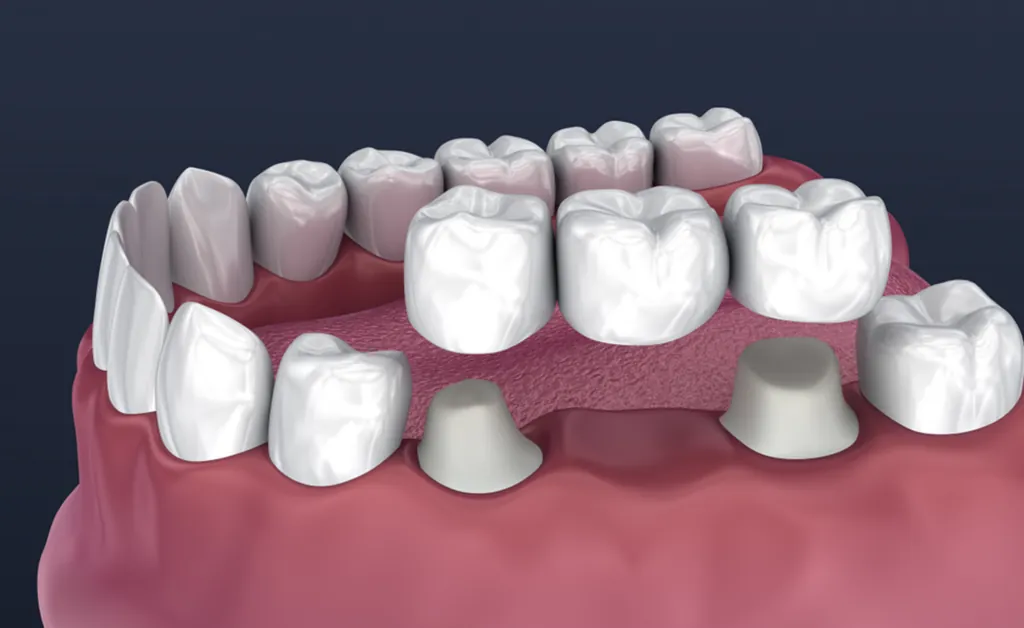
A dental bridge is a fixed prosthetic restoration that replaces one or more missing teeth by anchoring artificial teeth (pontics) to the natural teeth on either side of the gap. Unlike dentures, a bridge is permanently cemented and functions just like natural teeth, you eat, speak, and smile with full confidence.
The two natural teeth adjacent to the gap (abutment teeth) are prepared to receive crowns, which support the bridge. The pontic, the artificial tooth spanning the gap, sits between these crowns and is fabricated to match the colour and shape of your natural teeth precisely. The result is a seamless, functional restoration that lasts 10–15 years with proper care.
Bridges are a proven alternative to dental implants when implant surgery is not suitable, when a patient prefers a non-surgical solution, or when adjacent teeth already need crowns. Our dentists will assess your specific situation and recommend the most appropriate tooth replacement strategy.
Why Dental Bridges?
Understanding the purpose behind your treatment helps you make confident, informed decisions about your oral health.
Prevent Teeth from Shifting
When a tooth is lost, the adjacent teeth gradually drift into the empty space and opposing teeth over-erupt. This misalignment affects your bite, increases wear, and makes future restorations more complex. A bridge prevents all of this.
Restore Chewing & Speech
Missing teeth, especially back molars, significantly reduce chewing efficiency. A bridge restores full function, allowing you to eat a complete diet and speak clearly without embarrassment.
Fixed, Permanent Solution
Unlike removable partial dentures, a bridge is cemented permanently. It looks, feels, and functions like your natural teeth, with no daily removal or soaking required.
Non-Surgical Tooth Replacement
For patients who prefer not to undergo implant surgery, a bridge provides a reliable, non-invasive alternative that can be completed in two home visits.
Is Dental Bridges right for you?
Understanding who benefits most from this treatment, and who may need a different approach, helps you make a confident, informed decision about your care.
A bridge is highly effective for replacing one to three missing teeth in a row, supported by solid natural teeth on both sides of the gap.
Bridges require no surgery or osseointegration healing period, making them ideal for patients who cannot or prefer not to undergo implant surgery.
When neighbouring teeth already have large fillings or require crowns, a bridge is doubly efficient, one procedure addresses two clinical needs simultaneously.
Insufficient bone, uncontrolled diabetes, heavy smoking, or certain medications may contraindicate implants, a bridge provides an equally functional alternative.
A bridge spanning a large gap places excessive stress on the abutment teeth. Implants, implant-supported bridges, or partial dentures are more appropriate for extended edentulous spans.
Preparing intact healthy teeth for bridge abutments removes enamel permanently. Where adjacent teeth are sound and implants are viable, an implant is the more conservative choice.
Bridges cannot accommodate jaw growth. Tooth replacement in young patients should be deferred until skeletal development is complete, typically the late teens.
Bridge abutment teeth must be periodontally sound. Active gum disease must be fully treated and stabilised before bridge placement to ensure long-term success.
How we do dental bridges
Every step is performed by certified dentists at your home in Hyderabad, with fully portable, sterilized clinic-grade equipment.
Assessment & Treatment Planning
The dentist evaluates the gap, assesses the health of abutment teeth, and discusses the bridge design, material options, and expected outcomes.
Abutment Tooth Preparation
Under local anaesthesia, the two teeth adjacent to the gap are reduced to receive crowns. These prepared teeth will support the entire bridge structure.
Impression & Temporary Bridge
A precise impression is taken of the prepared teeth and opposing teeth. A temporary bridge is placed to protect the prepared teeth and restore aesthetics while the permanent bridge is fabricated.
Laboratory Fabrication
The dental laboratory crafts the three-unit (or larger) bridge to precise measurements. Colour matching and occlusal design are detailed in the prescription.
Final Fitting & Cementation
The permanent bridge is tried in, checked for fit, bite accuracy, and colour match. When everything is satisfactory, it is permanently cemented and polished to a natural finish.
Aftercare for Dental Bridges
Follow these guidelines after your treatment to ensure the best possible healing and long-term results.
Avoid Hard and Sticky Foods Initially
Allow cement 24 hours to fully set before chewing normally. Avoid sticky foods that could shift or dislodge the newly placed bridge.
Clean Under the Pontic Every Day
Food and plaque accumulate beneath the artificial tooth. Use a floss threader, superfloss, or interdental brush to clean under the bridge daily without fail.
Use a Floss Threader
Standard floss cannot pass through a cemented bridge. A floss threader or superfloss is essential, your dentist will demonstrate the correct technique.
Expect a Brief Adjustment Period
Speech and biting may feel slightly different for the first week as you adapt to the bridge. This resolves fully and quickly.
Attend 6-Monthly Check-Ups
Bridges require professional monitoring, the cement seal, abutment tooth health, and gum beneath the pontic must all be assessed regularly.
Report Any Loosening Immediately
Any sensation of looseness must be assessed promptly. A loose bridge allows bacteria beneath the cement, risking decay of the supporting teeth.
The Prudentoe Advantage
We bring the full capability of a modern dental clinic to your living room. The same certified doctors, the same sterilized instruments, the same clinical standards, with the comfort and convenience only a home visit can provide.
Autoclave-sterilized instruments, single-use consumables, PPE, and sterile drapes for every patient.
Dental chair, LED surgical light, high-speed handpiece, ultrasonic scaler, and complete instrument kit.
Dr. Vidushi Agarwal and Dr. Rohan Kotoju are BDS-certified with extensive clinical experience.
Book online or on WhatsApp. We confirm your appointment and send doctor details within 30 minutes.
Frequently Asked Questions
Everything you need to know about dental bridges, answered clearly.
Dental Bridges at home, in your neighborhood
Prudentoe brings dental bridges to your home across all 30+ Hyderabad neighborhoods. Click your area for local details.
Related treatments
Dental Crowns
Full-coverage restorations that rebuild, protect, and revitalise damaged teeth.
Learn more →Dental Implants
Permanent, natural-looking tooth replacement with preserved jawbone and lifelong results.
Learn more →Dentures
Complete or partial removable tooth replacement for restored function and confidence.
Learn more →Across Hyderabad
We perform dental bridges at homes across these neighbourhoods. Not your area? WhatsApp us to confirm.
Ready to book your dental bridges at home?
Our certified dentists will come to your home anywhere in Hyderabad, fully equipped, fully sterilized. Confirmation within 30 minutes.